The salary question often comes up early, before you know much about the job.
That timing matters. The interviewer is usually checking whether your expectations fit the compensation band they already have and trying to avoid a surprise later.
You do not need to guess perfectly. You do need to avoid giving a number you cannot explain.
A good answer connects three things:
- what the role actually involves
- what comparable roles pay in that market
- the range that would make the opportunity worth considering
What candidates often get wrong
There are three common mistakes.
Giving one hard number too early
If you name one figure before you understand the scope, you can anchor yourself to the wrong job. The title may sound familiar, but the responsibilities can vary a lot between companies.
You need enough context to know what the work actually is.
Refusing to answer at all
You can ask for the employer's range first. You can also say you want to understand the role before narrowing your answer.
But if you avoid the topic completely, both sides lose time. The company needs to know whether the role is financially workable for you, and you need to know whether the role is worth continuing.
Anchoring to your current salary
Your current pay may reflect a different employer, market, level, or point in your career. It is not automatically the right benchmark for the next job.
A better question is: what does this role pay, and where should your experience place you within that range?
Build your answer before the interview
Use this process to prepare.
1. Understand the scope
Start with the job description, then look for gaps.
Ask yourself:
- What would I own?
- Who would I work with or manage?
- What decisions would I be expected to make?
- Are there technical, sales, leadership, or client-facing requirements?
- How would success be measured?
- Is the posted title consistent with the actual level of responsibility?
The more the role includes, the more carefully you should compare it with similar positions. Do not benchmark yourself against a title alone.
2. Research the market using dated sources
Use current information and note when you found it.
First, review live job postings for the same or a closely related role in the same market. Focus on postings that show a salary range. Compare responsibilities, seniority, location, and work arrangement rather than copying the first number you see.
Second, check government wage data where it is available. In the United States, the Bureau of Labor Statistics’ Occupational Employment and Wage Statistics program provides wage estimates by occupation and location. The May 2025 OEWS estimates were released on May 15, 2026. The occupation categories may not match your exact job title, so use them as a reference point, not a precise answer.
You can also compare that with current salary guides and compensation articles. Robert Half’s article on salary expectations, published August 28, 2026, recommends reviewing current postings and adjusting for experience, skills, and qualifications. Indeed’s guide, updated July 30, 2026, also recommends comparing market data with the role, location, experience level, and total compensation.
Your notes should include:
- source name
- job title or occupation
- location
- date checked
- listed range or wage information
- responsibilities that make the comparison useful
3. Set a target and a private minimum
You need two numbers of your own before the conversation: a target and a private minimum.
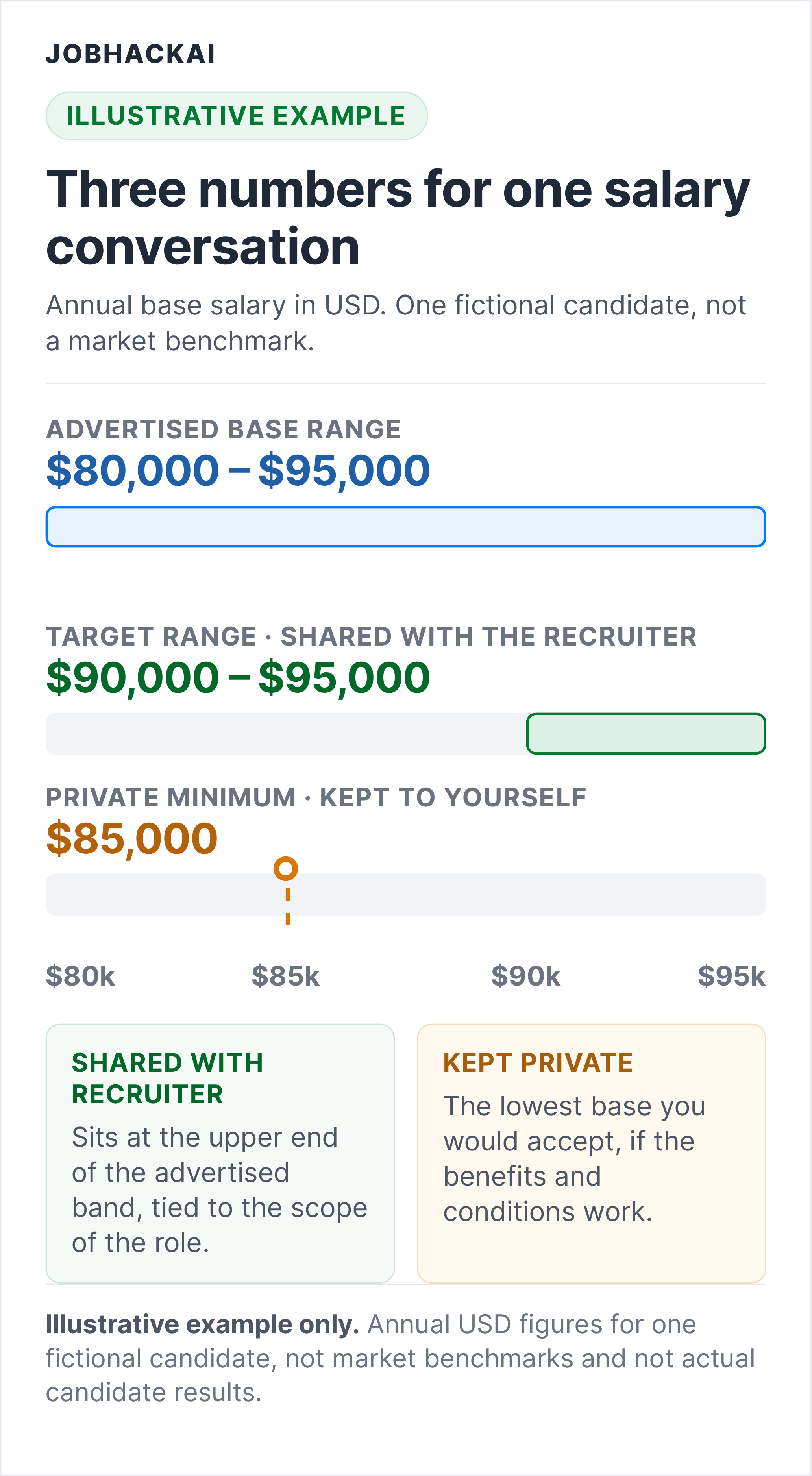
For one fictional example used for illustration, imagine a candidate interviewing for a role with an illustrative annual USD base salary range of $80,000 to $95,000. These figures are examples only. They are not market benchmarks and not actual candidate results.
The candidate's target is the range they are comfortable sharing once they understand the role: $90,000 to $95,000 in illustrative annual USD base salary.
The candidate's private minimum is different. It is the lowest illustrative annual USD base salary they would seriously accept for this role: $85,000, assuming the benefits and working conditions are acceptable.
That private minimum is for personal decision-making. It is separate from the $90,000 to $95,000 range shared with the recruiter.
Three numbers for one salary conversation
Shared with recruiter
Kept private
Compare the offer, not just the base salary
| Offer | Base salary | Bonus | What it means |
|---|---|---|---|
| Offer A | $90,000 | None | Guaranteed base salary of $90,000 |
| Offer B | $85,000 | 10% target bonus | Could total $93,500 if the bonus pays in full, but the guaranteed base is $85,000 and a target bonus is not guaranteed |
Offer B could total more if the bonus pays in full, while its guaranteed base is lower.
Benefits and conditions also matter: health coverage, paid time off, retirement contributions, flexibility, and working conditions all affect whether an offer works.
4. Tie the range to the role
A salary range without context can sound arbitrary. Give the interviewer one clear reason for it.
That reason could relate to:
- the level of responsibility
- relevant experience
- a specialized skill
- leadership scope
- the local market
Keep the explanation short. You are showing judgment, not giving a presentation.
Two illustrative answer scripts
The scripts below follow the same fictional example used for illustration. All dollar figures are illustrative annual USD figures, not market benchmarks and not actual candidate results.
Early recruiter screen, before the responsibilities are clear
"I saw the advertised range of $80,000 to $95,000. That broadly fits what I'm looking for. I'd like to understand the responsibilities before narrowing it down."
Later-stage conversation
"Based on the scope and my experience, I'm targeting $90,000 to $95,000 in base salary, depending on the overall package."
The later answer is more specific because by that stage the candidate knows the responsibilities. The range narrows to the upper part of the advertised band and gives a reason for it.
If there is no advertised salary range
This situation is different, so treat it separately.
If no range is posted and the employer will not share one, use a researched range you can explain and keep the wording simple:
"Based on comparable roles in this market and the experience I would bring, I'm targeting [your researched range] in base salary."
That is different from the advertised-range example above. In one case you are reacting to a posted band. In the other, you are working from your own market research.
What to say when they push for your number first
Some interviewers will ask for your expectation before sharing the band. Ask once, clearly and professionally:
"I'm happy to discuss compensation. Before I give you a range, could you tell me what salary band has been approved for the role?"
If they keep pressing, do not turn it into a standoff. Give the best range you can support with your research.
If the employer shares a band that is below your private minimum, be direct:
"Thank you for sharing that. Based on my research and the responsibilities we discussed, my target is higher. Is there flexibility in the range or in other parts of the package?"
If the answer is no, you can decide whether the opportunity still works.
Practice the answer out loud
Write down your own range and one clear reason for it.
Then rehearse the early answer:
- when you know the posted range but do not yet know the full responsibilities
- when you want to show interest without getting pinned to one number too early
Then rehearse the later answer:
- when the scope is clearer
- when you can narrow your range and tie it to the role
After that, listen for unnecessary detail. If you start explaining every part of your work history, cut it back. Refine until the answer sounds clear, calm, and easy to say aloud.
Optional drill guidance: practice a 45 to 75 second version first, then compress it to roughly 30 to 45 seconds. That is only a rehearsal exercise. It is not an answer-length rule and not a scoring standard.
You can also practice this kind of answer out loud with JobHackAI as part of a role-specific interview session. Read the mock interview practice guide for a structured way to prepare around a real job description.
Final takeaway
You do not need to predict the exact offer in response to "What are your salary expectations?"
You need a defensible range, a private minimum, and a short reason tied to the role.
Research the market, understand the job, and keep the answer practical. That gives you a better way to handle the conversation without boxing yourself in too early.
Sources
- U.S. Bureau of Labor Statistics: Occupational Employment and Wage Statistics, May 2025 estimates released May 15, 2026. Use this as a reference point; the occupation categories may not match your exact job title.
- BLS Occupational Employment and Wages news release: official wage and employment data by occupation.
- Robert Half: How to answer “What are your salary expectations?”, published August 28, 2026.
- Indeed: Interview Question: “What Are Your Salary Expectations?”, updated July 30, 2026.